
Knowledge base · Sauna
Infrared sauna or Finnish sauna: what is the difference?
An infrared cabin uses emitters that warm your skin directly. A Finnish sauna warms the air in the cabin with a heater and stones. This article compares temperature, connection and use, and discusses what the research does and does not show.
 Loading photo
The answer
Air or radiation
Two ways of heating, and you notice it in use.
In a Finnish sauna a heater with stones warms the air to 80 to 100 degrees, and that hot air warms you. In an infrared sauna the air stays at 45 to 60 degrees. The warmth comes from elements that radiate directly onto your skin. You sweat in both, but you go in differently and come out differently.
You notice that difference before you even sit down. A Finnish sauna needs time to bring the stones and the cabin up to temperature. Whoever switches it on is planning an evening. An infrared cabin is ready quickly, because no room full of air has to get hot. That is why infrared fits into an ordinary weekday evening.
The ending differs too. In the Finnish sauna water goes onto the stones, the löyly rolls through the cabin and afterwards you go looking for the cool air. Infrared has no such pouring: the warmth is dry and stays mild, and the session winds down more quietly. If you want both rituals at home, look at a combi sauna: Finnish heat and infrared in one cabin. It does inherit the requirements of the Finnish side, three-phase power and ventilation.
The technology
Four differences that are fixed
Temperature, connection, moisture and location. None of this changes from one model to the next.
These four points decide what is possible at your home, whichever model you choose.
Temperature
45 to 60 against 80 to 100 degrees
An infrared cabin keeps the air between 45 and 60 degrees. The warmth is in the radiation, not in the air. A Finnish sauna goes to 80 to 100 degrees. The Finnish study everyone refers to (JAMA Internal Medicine, 2015) was done at an average of 79 degrees.
Connection
230 V against three-phase power
Infrared runs on an ordinary 230 V circuit. A Finnish sauna almost always needs three-phase power: in our practice that is 3× 400 V in around 95 per cent of cases, and only very small Finnish models run on 230 V. Our external partner assesses whether your electrical panel is suitable.
Moisture
Pouring water is Finnish
Water on the stones belongs to the Finnish sauna and to nothing else. Infrared is dry warmth without stones and without a heater, so without pouring as well. A combi sauna has both.
Location
Bathroom, basement or garden
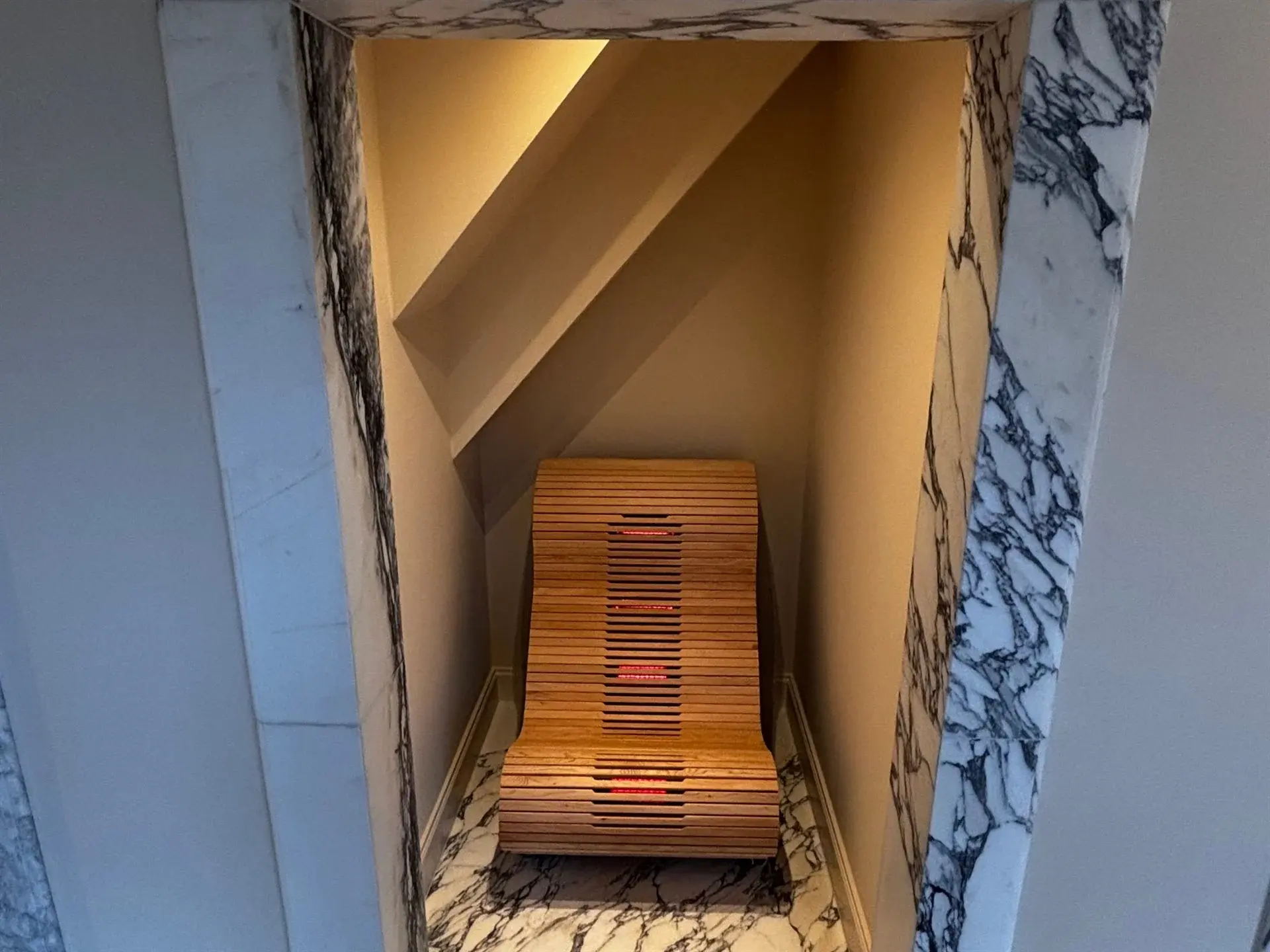
Both types can stand indoors and outdoors. Thanks to its light connection, infrared also fits in places where three-phase power is awkward: in Bussum we placed an infrared lounger in its own alcove in a bathroom. A Finnish sauna needs ventilation with an inlet and an outlet, and almost always the cable to the meter cupboard.
The research
Research by sauna type
What the cohort study says, what the infrared studies say, and why you may not add them together.
This is where the market most often goes wrong. The Finnish sauna research is quoted for infrared cabins as well, even though it is about a different product. We draw that line sharply, even though we sell both.
Does the Finnish heart study also apply to infrared?
No, and the researchers say so themselves. In JAMA Internal Medicine, 2015, they followed 2,315 Finnish men for more than twenty years. Those who went to the sauna four to seven times a week came out better than those who went once a week. The saunas measured averaged 79 degrees, with water on the stones. The authors note that their results do not simply carry over to steam rooms, hot tubs and sauna types that work at lower temperatures and where water cannot be poured. An infrared cabin is exactly such a type. And for the Finnish sauna too it remains observational: those who sauna often came out better. It says no more than that.
What do the studies of infrared itself find?
They are small, and they do not find the same thing. In Complementary Therapies in Medicine, 2022, ten healthy women each spent 45 minutes in an infrared cabin, on a bicycle and at rest. Body temperature rose in the cabin, but blood pressure, arterial stiffness and heart rate variability did not differ: not between infrared and rest, and not between infrared and cycling either. In the American Journal of Physiology, 2025, three heat sources were measured side by side in twenty healthy adults: core temperature stayed the same with infrared, rose 0.4 degrees in the traditional sauna and 1.1 degrees in the hot bath. With ten and twenty participants, those studies do not prove that infrared does nothing. They do show that “the same effect, only easier” rests on nothing.
Is there no research that speaks in favour of infrared, then?
There is, but it concerns patients. In Japan mild infrared warmth is used as Waon therapy for heart failure: a quarter of an hour at 60 degrees, followed by half an hour of bed rest under a blanket, ten days in a row. The largest randomised study of it, in Circulation Journal, 2016, with 149 hospitalised patients in nineteen hospitals, saw walking distance and symptom class improve, but did not meet its primary endpoint, a blood marker. Clinical work with ill people under medical supervision is not a lifestyle promise for a healthy buyer. What you may expect from an infrared cabin is the experience: mild warmth, quickly available, a session that fits into a weekday evening.
Points to consider
What you can compare in the showroom
You can try working infrared cabins. With Finnish saunas you can compare the construction and finishes; these are switched off.
In our showroom in ’s-Graveland you can try working infrared cabins. Finnish saunas and spas are switched off; you can compare their dimensions, layout and finishes. No swim spa is on display. Swim spa consultations take place in the showroom; test swims are arranged at an external location.
Carlo and Max explain the differences. Discuss your available space, connection and heating preferences during your consultation.
In practice
What changes at your home
Four things we go through in the consultation.
Which type suits you is something we decide together. What it asks of your home is set out here in advance.
- The meter cupboard. Infrared runs on 230 V. A Finnish sauna almost always needs three-phase power, and whether that cable is already there is something you can see in the meter cupboard. We manage the whole project around the installation. We arrange the connection itself through an external certified partner.
- The location. An infrared cabin fits in a bathroom, a basement or, as an outdoor model, in the garden. In Amsterdam we placed an infrared barrel sauna next to a Python spa and an outdoor shower. A Finnish sauna needs ventilation and room to cool down afterwards.
- The ritual. Which evening do you picture: a short session after work, or a longer sauna session with pouring and cooling down? How you plan to use it matters. That is where our advice starts.
- The warranty. The infrared emitters of the i-series and the Glass series carry a 20-year warranty. The sauna as a whole carries two years; for the other models the emitter warranty is shown with the model. A heater may differ according to the manufacturer’s warranty.
Safety
Using heat safely
With heart complaints, consult first. That applies to both types.
We do not give health advice. If you have unstable angina, a recent heart attack or a severe narrowing of the aortic valve, the question of whether you may use a sauna belongs with your cardiologist or GP, whatever the type. Those three contraindications come from the overview by Hannuksela and Ellahham in The American Journal of Medicine, 2001. If you take medication that affects your blood pressure, consult as well.
Beyond that, the same down-to-earth rules apply as with any sauna. No alcohol beforehand, get out as soon as you feel light-headed, stand up slowly and drink water afterwards. If you are pregnant, the sources differ. Consult your midwife or doctor. And whichever type you choose, start with shorter sessions and build up.
Further reading
Related articles
Indoor saunas: infrared, Finnish and combi
Installation, connection and the saunas on display in the showroom.
Sauna and the heart: the Finnish research
What exactly was measured in Kuopio, with the researchers’ own reservations.
What a sauna does not do
Calories, detox, cortisol: the claims the market repeats and that do not hold up.
Having a bespoke sauna made
For a space where no standard sauna fits: how the process works and what drives the price.
How we checked it
Sources and author
Every study on this page has been checked in the original publication.

See the models
Compare saunas in the showroom
See Finnish saunas, infrared cabins and combination saunas on Loodijk in ’s-Graveland. We discuss your space, electrical supply and preferences.