
Knowledge base · Installation
Installing a hot tub: what needs to be in place beforehand
Before installation, we discuss the power supply, base and access. We usually do this remotely using your photos, videos and measurements. We arrange the electrics through an external certified partner.
 Loading photo
The answer
Power, ground and the route into the garden
Arrange those three in advance and on delivery day all you need is an empty spot and a garden hose.
Installing a hot tub is rarely the problem. The work lies in what has to be in place before that day: a circuit in the meter cupboard that can carry the spa, a base that keeps bearing the weight of a filled spa, and a route from the street to the spot in the garden.
Those three differ from house to house. An older home with a single-phase supply needs something different from a new-build with a heat pump and three phases, and a narrow gate needs a different plan from a driveway where the lorry can drive up to the back door.
Send photos, videos and measurements of the location and access route. We also look at access using Google Maps. Would you like us to come by? That is possible, by appointment.
Power
What power supply does a hot tub need?
Smaller spas run on a single-phase 230 V circuit. Larger models need three-phase power. Which circuit your model needs is stated in the quotation.
The question has two layers: what the spa needs, and what your house can deliver. The first we answer. The second is answered by a certified electrician, with the door of your meter cupboard open.
The spa
Single-phase 230 V or three-phase
The power supply and protective devices depend on the model and configuration. Use the installation manual for your chosen spa or swim spa. We pass the requirements to our external partner or to your own electrician, who assesses the distribution board, circuit and wiring before installation.
The house
What the main supply can carry
Grid operators work with fixed supply ratings for homes. In Het Gooi, North Holland and Flevoland that is usually Liander, elsewhere for example Enexis or Stedin. Common ratings are 1× 35 amps (maximum approx. 8 kW) and 3× 25 amps (maximum approx. 17 kW) (Enexis Netbeheer, 2026). Everything in the house shares that capacity: the hob, the heat pump, the car charger and soon the spa. Whether there is room to spare depends on what is already connected.
The cable
From meter cupboard to garden
The distance from the meter cupboard to the spa determines a large part of the installation work: an underground cable through the garden, sometimes a trench under the terrace. The electrician lays that cable before installation day. On the day itself we only connect.
Who decides
We arrange it, the electrician decides
Electrical installations in Dutch homes fall under the standard NEN 1010 (NEN, 2020 edition with the 2024 correction). A certified electrician installs the circuit and its protection to that standard and judges whether your supply needs upgrading. You then apply for that with your grid operator. We arrange this through an external partner and guide it fully, with all the information it takes. If you prefer your own electrician, we pass the details on to them. On the meter cupboard the electrician has the final say.
The ground
A base that keeps bearing the weight
Level, load-bearing and not settling. Usually a concrete slab, sometimes a properly founded deck.
Can a hot tub simply sit on the patio tiles?
That depends on the construction and load capacity of the terrace. A filled spa with users needs a level, stable base. We can take a look at photos with you. Have a contractor or structural engineer determine whether the existing base is suitable.
Concrete slab or deck?
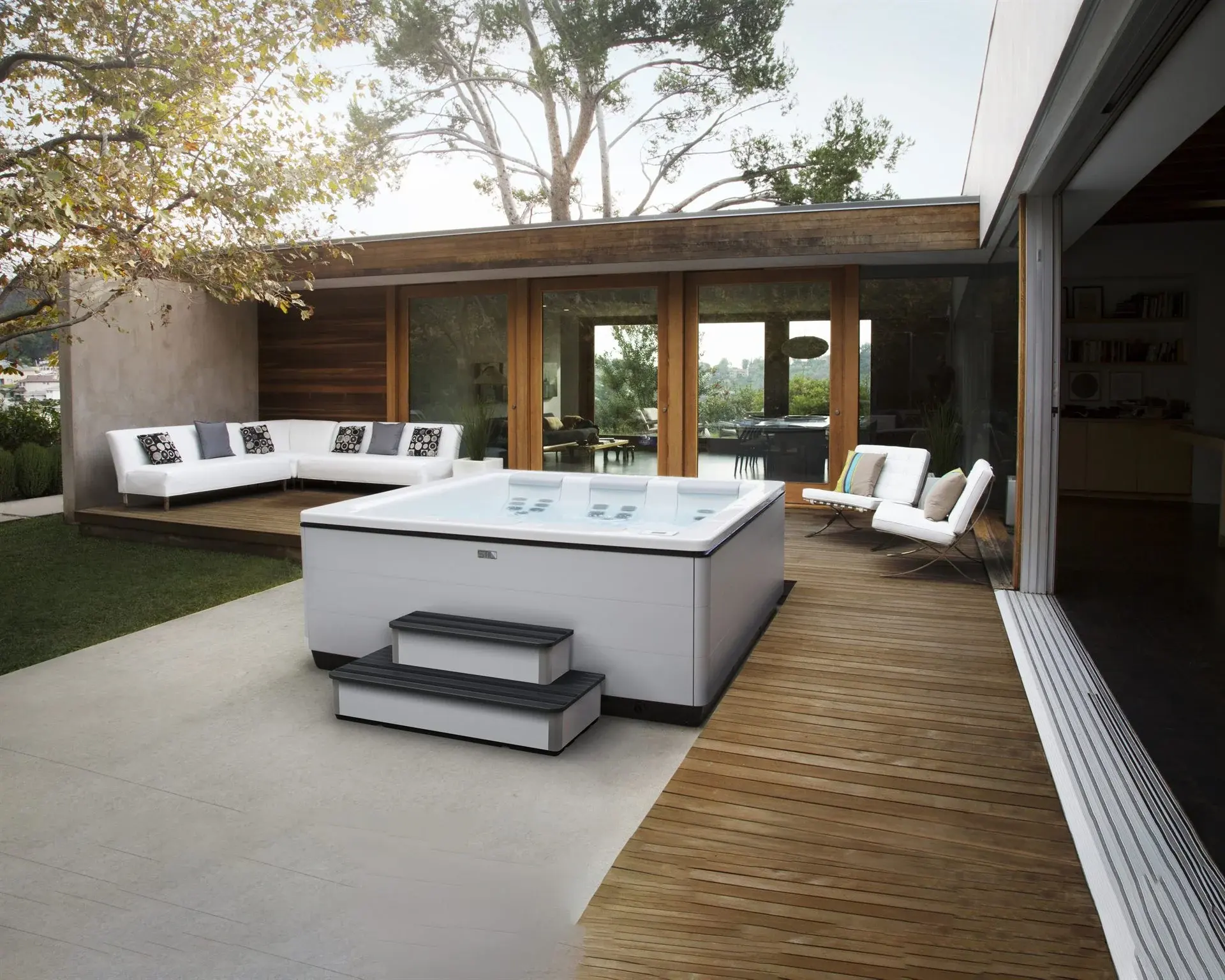
A concrete slab is the most common solution. A deck works too, as long as it stands on its own foundation that carries a filled spa without settling. In Amstelveen a Fox Cosmos stands on a Kerama deck. Which it becomes depends on your garden and on how you want the spa to look: on the terrace or on a platform of its own. How thick or how heavy the base has to be is decided by the party that lays it, not by this article.
Sand or peat: does the soil matter?
Yes. Het Gooi sits on an ice-pushed ridge: some 150,000 years ago land ice moved across the Netherlands and pushed up old river deposits (Geopark Heuvelrug Gooi en Vecht, 2026). Around the Vecht lakes lies a thick layer of peat. For centuries turf was cut and later dredged there, which is how the lakes near Loosdrecht came about. Peat gives and sinks under a permanent load. A terrace by the water therefore needs a different base from a garden in Laren or Blaricum. We install on both.
And if the base is not there yet?
Have the required foundation specified and installed before delivery. Arrange the work yourself or directly with a contractor we suggest. We can look at the situation with you.
The route into the garden
Sack truck, or a crane after all
If the spa fits through the gate, we wheel it through. If it does not, the crane is in the quotation beforehand.
Using photos, videos and your measurements, we look at whether the spa can reach the garden through the gate or alongside the house. We use Google Maps to look at the approach route. Include turns, changes in level and obstacles in your images.
If the gate is too narrow, if the garden can only be reached through the neighbours’ or if it lies behind an extension, we bring in a crane. Which crane depends on the distance from the street to the spot and on what stands in between: a shed, a tree, a roof edge. The further and the higher, the heavier the crane.
In the quotation beforehand
The crane type and the crane costs appear as a separate line in the quotation, before you sign. Not afterwards on the invoice.
Installation itself has a fixed price: € 695 for a spa and € 995 for a swim spa, with two fitters and no travel surcharge. We price the crane separately, so you see what you are paying for.
Points to consider
Every house is different
Power often turns out more expensive than expected, usually because of what is already in the meter cupboard.
We can tell you what the spa needs. What your house can deliver is only known to the electrician who opens the meter cupboard. A full consumer unit, a long distance to the garden or a main supply already busy with a heat pump and a car charger: then power becomes the item that takes longest and costs most. Sometimes the supply has to be upgraded. You apply for that with your grid operator, who first checks whether there is still capacity on the grid in your area and how long the upgrade will take (Enexis Netbeheer, 2026).
Discuss electrical preparation with us in good time. We bring in our external partner, pass on the installation requirements for your chosen model and agree installation with you.
In practice
Five things you arrange before delivery day
Agree in advance who prepares each part.
We discuss these points with you in advance, usually using photos, videos and measurements.
- Have the meter cupboard looked at. Our external certified partner or your own electrician assesses the circuit, the cable and whether an upgrade is needed. We pass on which supply your model requires.
- Choose the spot and have the base prepared. Level and load-bearing, usually a concrete slab. If it is not there yet, you arrange the construction yourself or through a party we suggest.
- Clear the route. Loose tiles removed, branches pruned, the gate unlocked. If the spa does not fit through, the crane is already in the quotation.
- Have water close by. An outdoor tap or a hose reaching the spa is enough. We fill it on the day itself and take the first water reading straight away.
- Leave the permit check to us. We check with your municipality whether the spa can be placed without a permit, as part of the project and without a separate charge. If needed, we support you with the application.
Further reading
Related articles
Service
Delivery and installation: the six steps
From remote preparation to installation and instructions: who handles what?
Knowledge base
Permits for a spa or sauna in Het Gooi
Usually not needed, sometimes it is. Explained per municipality in Het Gooi, with the official permit check.
Knowledge base
What a spa uses in electricity
Insulation, cover and heat pump determine consumption. How to work out a guide figure yourself.
Accountability
Sources and author
Company facts from our own way of working. External facts with name and year.

The first step
Prepare for installation with us
Send photos, videos and measurements of the location and access route. We also look at access using Google Maps. Would you like us to come by? That is possible, by appointment.